Laser Hair Removal
Pilonidal Sinus Disease

Laser Hair Removal
Pilonidal Sinus Disease
What is Pilonidal Sinus Disease, and how can laser treatment reduce recurrence after surgery?
A Pilonidal Sinus is a small hole or "tunnel" in the skin commonly developing in the cleft of the buttocks where the buttocks separate, causing the formation of a cyst or abscess.
A Pilonidal Cyst usually contains hair, dirt, and debris. If it becomes infected, it may ooze pus and blood and have a foul odour. Signs that you may have an infection include pain, redness and swelling in the affected area.
Why do Pilonidal Sinuses happen?
The exact cause of a Pilonidal Sinus is unclear, although it is thought to be caused by loose hair piercing the skin.
Certain things can increase your chances of developing a Pilonidal Sinus, such as being obese, having a large amount of body hair, and having a job that involves a lot of sitting or driving.

Activities that cause friction, like sitting, can force the hair growing in the area to burrow back under the skin. The body considers this hair foreign and launches an immune response against it, similar to how it would react when dealing with a splinter. This immune response forms the cyst around your hair. Sometimes a person may have multiple sinuses that connect under the skin.
How is it treated, and after treatment, how do you reduce recurrence?
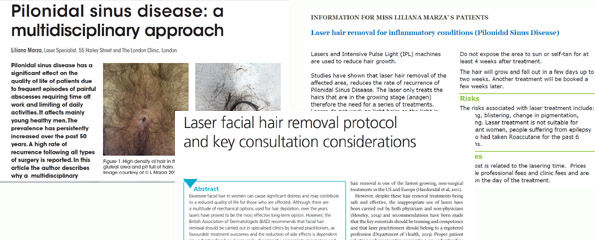
Pilonidal Sinus Disease (PSD) is an inflammatory condition, primarily treated with surgery and with a high rate of recurrence. Research has shown that lasers can reduce the rate of recurrence. This is an effective treatment for Pilonidal cysts, and provides excellent results with quick healing and no risk of serious adverse side-effects. Laser hair treatments are recommended by clinicians before and after surgery. (See below - Marza 2013 - Reducing the recurrence of pilonidal sinus disease. Nursing Times article)
Miss Liliana Marza has extensive experience in successfully treating patients with Pilonidal Sinus Disease with lasers in a hospital environment. She works closely with colo-rectal and plastic surgeons carrying out treatments of PSD and has assistance from a nursing team specializing in wound care. Her work has been widely referenced and used by NICE (National Institute of National Excellence) in the development of national guidelines for the management of Pilonidal Sinus Disease. https://cks.nice.org.uk/pilonidal-sinus-disease.
Liliana has written articles on PSD condition in medical and nursing journals in UK and abroad (see below) and has a surgical nursing background.
Treatments are performed at the hospital registered with the Care Quality Commission in a hospital environment with full medical support. Liliana has several lasers which can be used for a variety of conditions particularly in patients with darker skin complexion.

More information on Facebook